Collecting some information from Taipower website:
Various types of power generation sources are rather clearly identified on the Taipower website with a table listing the sources to the output energy and impact on reserve margin [1]. Tables are possible to be generated for specific days, or for a period of time. Most of the power sources are government run and funded, although there are listed five commercial coal power plants and seven natural gas plants. The energy output to types is plotted in the piechart.
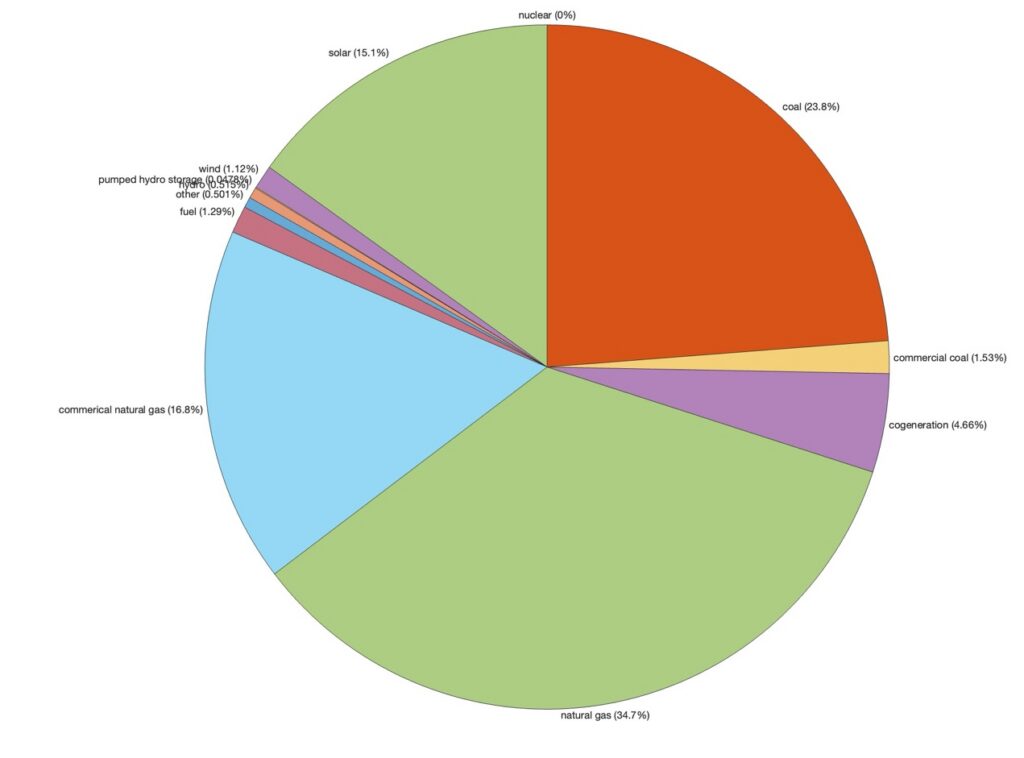
Figure 1. Data from Taipower website for April 15, 2026.
While geothermal power plants are being built in Taiwan, the power source is currently not listed on the table. The largest sources of output power are from natural gas. The net peak power supply capability, for example in 2024, is around 46 GW. Interestingly, solar is generating substantial amounts of power in Taiwan, at 15%, after natural gas and coal.
The costs for supplying power average to around NTD1.98/kWh for users in the residential sectors, particularly for low usage users. Energy cost to kWh is tiered, with heavy users paying more. For example, local commercial sectors users with greater than 1001 kWh consumption would pay around NTD8.86/kWh, around November 2025.
Low voltage energy (110 V, 220 V, 380 V at 60 Hz), specifically for electric vehicles have the following cost breakdown. Electric vehicle costs vary depending on the time of use. During summer, the off-peak costs are NTD3.05/kWh for Monday through Friday. This is the cost for the entire day during the weekend. Non-summer off-peak costs are NTD2.9/kWh. During summer time peak hours, from 4 pm to 10 pm, energy costs NTD12.47/kWh. During non-summer peak hours, 3 pm to 9 pm, the cost is slightly less NTD12.14/kWh. These are the additional costs on top of a base cost and contract, which amounts to around NTD310 per month (?).
Maintaining working power infrastructure is critical. Recent methods for inspection include utilizing infrared thermal imaging to locate excessive heat load hot spots. Most of these, in Taiwan, come from manual inspection, and are not yet drone based (?). “The system comprises 10,000 feeder lines, totaling approximately 440,000 kilometers in length—enough to circle the Earth 10 times. It also includes 1.57 million switches and 1.58 million transformers, along with about 3.26 million utility poles.”
References