Redwood Coast Airport Microgrid
The Redwood Coast Airport Microgrid (RCAM) project is the first front-of-the-meter (FTM) multi-customer community microgrid in Pacific Gas and Electric Company’s service territory. Information about this microgrid, which is on the utility side, is available at the website (https://redwoodenergy.org/about/community-impact/rcam/). The microgrid serves 19 retail customers as well as the Redwood Coast-Humboldt County Airport and US Coast Guard Sector Humboldt Bay Air Station. The prime contractor Schatz Energy Research Center has a website with detailed information and project reports (https://schatzcenter.org/acv/). In Humboldt County, this community microgrid control system has 2.2 MW solar array DC-coupled with 2.3 MW (alternating current)/8.9 MWh lithium-ion battery energy storage. There is also a 300 kW (alternating current) net metered solar photovoltaic array system, and four 20 kW (direct current) bi-directional, behind-the-meter electrical vehicle chargers.
As reported on the website, on December 20, 2022, when a 6.4 magnitude earthquake knocked out power to 70000 users of Humboldt County, the microgrid disconnected from the electric grid and was able to supply power to the airport and Coast Guard for nearly 15 hours. The microgrid circuit has an aggregate peak load of ~330 kW.
The concept of the microgrid is that of an energy island. When there is a larger power outage event in the electric grid, microgrids are able to disconnect and continue to run for a fixed period of time. These microgrids are being designed for fire stations, hospitals, schools, grocery stores and critical infrastructure such as emergency command operations centers. In total, the seamless transitions to islanded mode at the RCAM has provided reliable, safe, grid quality renewable power to loads during 63 islanding events over a sum of 71.8 hours of grid outage in a 38-month period.
The Redwood Coast Airport Microgrid is funded from two primary sources: a $5M Electric Program Investment Charge (EPIC) grant from the California Energy Commission and a $6.5M low-interest loan from the Rural Utilities Service of the USDA. The FAA permitted the building of the microgrid at the airport, which contracted out the work to a commercial entity. The Humboldt County also provided a building permit for the specific construction of photovoltaic array, medium voltage interconnection and communication equipment. The owner of the utility is the Redwood Coast Energy Authority, working in conjunction with Investor Owned Utility (IOU) PG&E, the owner of the distribution lines. Several companies and labs, including Tesla, worked together to provide the control hardware, software, photovoltaic and battery systems. A Technical Advisory Committee of 17 individuals was convened multiple times during the project, with the members chosen from investor-owned and publicly owned utilities, community choice aggregators (CCAs), airport executives, emergency services personnel, regulators, National Laboratory personnel, and consultants from the energy industry. The committee helped to ensure the following project tasks were on track: 1) project initiation and operational agreements 2) design and permitting 3) procurement, construction, testing, commissioning and training 4) operation, data collection and analysis 5) business model evaluation and market replication assessment 6) technology and knowledge transfer. The RCAM project was initially scoped for a four-year duration, which was extended to six years and began in 2017. The RCAM microgrid has been fully functional since May 2022.
In practice, as the microgrid is owned by one utility and distribution is handled by another utility, there are going to be separate line items in the bill — one for the electricity generation and one for the distribution. In this particular instance, PG&E handles all billing in an approximately monthly cycle, and thus, the charge appears as if PG&E is billing for generation. PG&E provides a credit so that the bill is only for distribution. Generation charge rates as of February 1, 2026 are in the range $0.019 /kWh to $0.24 /kWh, for winter to summer. The bills are typically very detailed with off-peak and peak line items.
Rebates are available for residents to upgrade to energy-efficient appliances, heating systems, water heaters and others.
The Redwood Coast Airport Microgrid development is summarized in a project report, publication number CEC-500-2026-006 (https://www.energy.ca.gov/publications/2026/redwood-coast-airport-microgrid), dated January 2026. Several contributions are detailed 1) The solar photovoltaic power dispatched has largely met or exceeded expectations in both grid connected and islanded meters 2) expected annual revenues from the fully operational front-of-the-meter solar and battery system, based on actual market performance are ~$150k – $200k (due to direct current converters issues, the actual revenues ranged from $80k – $128k annually from 2022 through 2024) 3) policy efforts led to the creation of a Community Microgrid Enablement Tariff which became a statewide Multi-Property Microgrid Tariff and Microgrid Incentive Program — steps taken to put in place a regulatory framework and incentive program to facilitate replication of community microgrid projects statewide. Several key challenges remain 1) costs outweigh monetizable benefits partly due to the difficulty in quantification of value of resilience 2) complexities in the development and deployment of multi-customer community microgrid 3) high cost and complexity from owning and operating multi-customer community microgrid in a wholesale electricity market.
Several recommendations for next steps include research on advanced community microgrids that have vehicle-to-grid integration, frequency regulation, and smart inverter droop settings to manage inverter-based distributed energy resources.
Electrical: the microgrid has an important component called the recloser that is the main boundary switch between microgrid and utility grid. This recloser is the point of common coupling (PCC) which is able to automatically disconnect or reconnect depending on grid conditions. Advanced recloser controls, such as the SEL-651R, are designed to meet IEEE 1547-2018 standards. Key parts of the recloser include an intelligent controller (microprocessor-based relays that make logic-based decisions), switchgear (vacuum interrupter that physically opens or closes the circuit) and sensors (current and voltage transformers providing real-time data). At RCAM specifically, a G&W Viper-ST pole-mounted line recloser is automatically controlled by a SEL-651R recloser control relay. A manually operated air switch is also included in the system for bypass operations. These are standard recloser assemblies for PG&E.
Some of the main functions of the RCAM circuit are to supply backup power for the nearby airport’s Medium Intensity Approach Lighting System with Runway Alignment Indicator Lights (MALSR). Note that the runway lighting system at the airport was upgraded to light emitting diode technology, with estimated electricity consumption reduction of more than 50 percent.
Four data collection points provide metrics on the entire PV+BESS microgrid. Point A is the BESS meter that measures power flow imported to or exported from the BESS, Point B collects weather information and DC power to the PV arrays that feed the Tesla Megapacks, Point C measures power flow from BTM PV system to grid, and Point D collects information on whether the microgrid is in grid-following or islanded operation (at the recloser controller). Data is tracked and averaged on a 15 minute interval with monthly interval performance reports. Note that of the 74 islanding events recorded, 63 were successful while in 11 RCAM system failed to island. These issues were fully monitored by the data collection points with suggested future improvements (for example related to transformer grounding). During the island failure, existing backup diesel generators were used to provide emergency backup power.
Renewable Energy Certificates measure the amount of renewable energy generated, and in this instance, are captured by a single certified AC meter for the DC-coupled solar PV plus BESS resource. Essentially, the net export from the PV+BESS system is considered to be from the renewable resource. A detailed business model assessment is provided in the project report, although the authors are honest that the market is evolving with many of the built-in assumptions continuing to shift with time. The fundamental and basic premise of the business model is that of a public entity deploying a community microgrid to provide resilience benefits to critical community facilities that provide services during emergencies and natural disasters and when the bulk electric grid has failed. This public entity is interested in advancing clean energy goals for the community, and is amenable to the deployment of a community microgrid where a third party owns and operates a wholesale generator that becomes the grid-forming generator and serves retail customers on the islanded microgrid via the distribution utility’s electrical distribution infrastructure. These arrangements were essentially codified in a multi-property microgrid tariff, and approved by the California Public Utilities Commission (CPUC). Table 1 provides the RCAM Project costs.
Cybersecurity concerns were mitigated by a physical disconnection between PG&E and RCEA controllers with routable connections — which allow devices on different networks to communicate and with the public Internet. In this case, the connection was non-routable and could not be directly accessed from the public Internet.
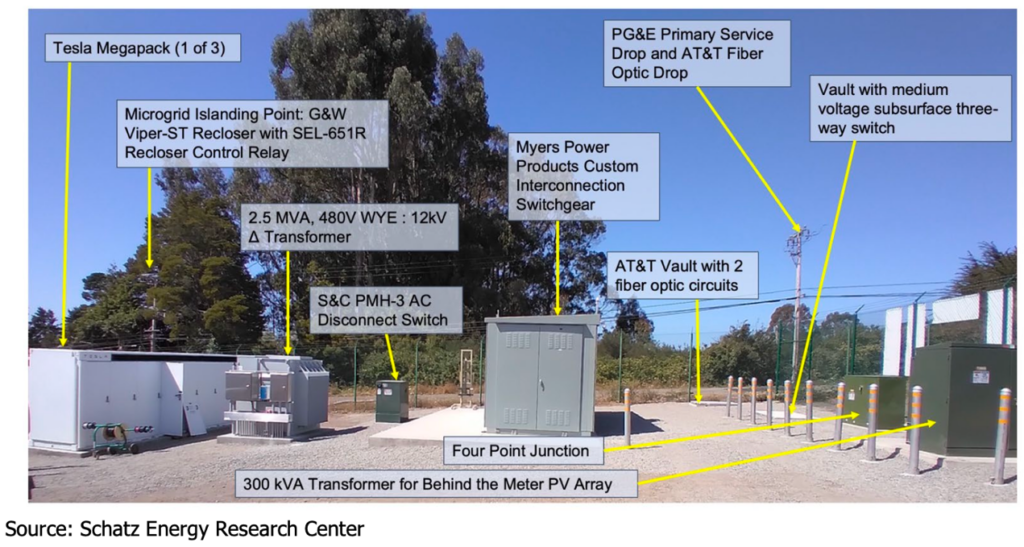
Figure of the Completed Microgrid Switchyard (from CEC-500-2026-006 report).
Keywords: front-of-the-meter, multi-customer, community microgrid, direct current coupled, microgrid tariff, microgrid operating agreement, resilience, wholesale electricity market
References.
- Vacuum Interrupters. https://www.youtube.com/watch?v=5jWc6Mei49k.
- SEL-651R. https://selinc.com/products/651R/.
Supplementary Information:
Performance and Testing –
Business Model Evaluation and Market Assessment –
Table 1. RCAM Project Costs (from page 65 of the project report).
| Component | Cost |
| Solar PV system and battery energy storage | $7,413,000 |
| Main microgrid switchgreat (point of common coupling, 12 kV) | $289,000 |
| Interconnection (includes: service realignment, generator interconnection facilities, distribution system upgrades) | $489,000 |
| Microgrid controls and protection | $695,000 |
| Civil and electrical balance systems (includes: land clearing, grading, concrete pads, fencing, trenching, underground vaults, conduit, wire, transformers, metering, permitting, inspections, and on-site testing services) | $293,000 |
| Engineering | $1,392,000 |
| Cybersecurity review and plan | $100,000 |
| Operations and maintanence | $145,000/year |
The 300-kW BTM solar PV system is interconnected with PG&E through a net metering aggregation arrangement. The PV system generates power and offsets a portion of the site host’s on-site electricity costs. Annual electric bill savings greater than $44,000 per year were achieved, since the time of the lease negotiation and shown to be equivalent to the fair market value of the lease.
The RCAM project has a total cost of $12.7 million and total revenue benefit of $5.5 million, leading to a benefit-cost ratio of 0.43.
Resource Adequacy (RA) remains a key revenue stream for storage resources.
During the market potential assessment, the company performing review identified the full market population of critical facilities throughout California, including wastewater treatment plants, hospitals, emergency medical services, police stations, fire stations, municipal facilities, emergency operations centers and emergency community shelters (high schools, for example). Facility size, credit rating, outage risk, transmission and distribution system constraints, lack of public support and other factors were assessed. Of the facilities identified as viable community microgrid candidates, the report indicated that there exists 200 MW to 400 MW renewable generation capacity and 800 MWh to 1600 MWh energy storage capacity potential.
On page 79 of the report, an estimate of the savings on carbon dioxide emissions is provided — assuming a carbon dioxide emissions factor of 0.233 metric tons per MWh. As the RCAM project delivered 2846 MWh from April 2022 through August 2025, savings were equivalent to 663 metric tons of carbon dioxide emissions.